
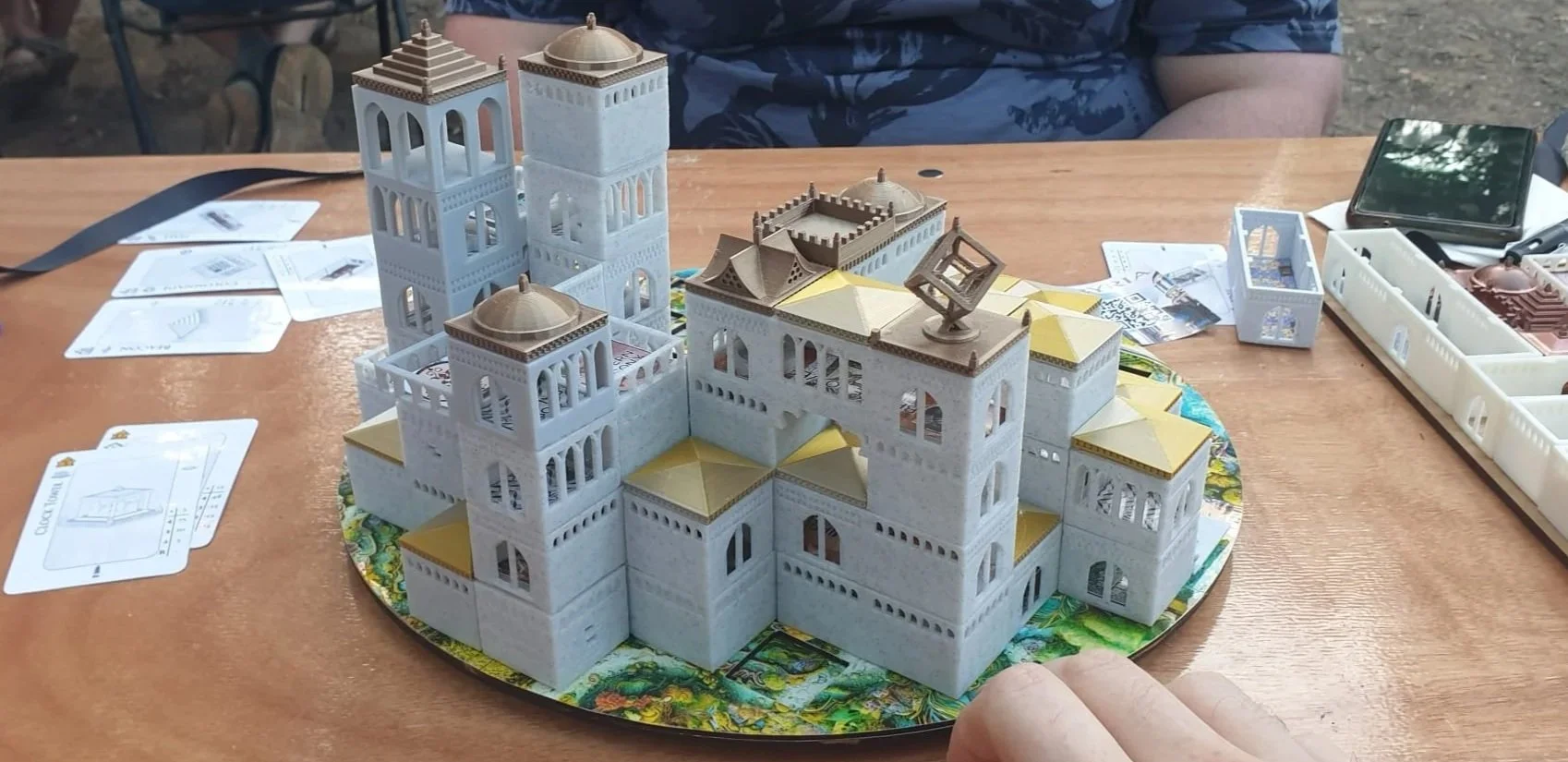
The Origin of Cubyria
When James was six, he attended one of those 1970s summer schools where kids were allowed to wander around unsupervised, like goats. One day he found his way into a temporary structure called ‘the portable,’ which stood empty most of the time, so he already felt like an explorer nosing around where he shouldn’t be.
On a shelf there was a map. A fortress stood alongside a long mountain range, and scrawled across it in calligraphic script it said, “Sir Rogan, you must come with haste! The orcs have ridden down from the passes and we are overrun. We will not hold out long.” Then the same writing, in livid red: “Ignore my blood…”
The red letters suggested a course of action that Sir Rogan was to follow to shore up the defenses of the kingdom, and young James’ head exploded in excitement. Eventually he learned the origin of this mystery, and spent many childhood hours playing D&D.
James was fascinated by systems and procedures, and also rather shy, so instead of taking up the charismatic role at the head of a game table, he would more often recruit his friends to help create new games. The DIY philosophy of the early RPG scene was his natural environment, and he spent many hours tweaking rules and inventing whole game systems before dropping them on his befuddled friends in one-shots that didn’t work. In other words, without ever meaning to, he became a game designer.
Many years passed. One chilly November day he attended Dragonmeet in London. His latest whimsy was a mini-game to simulate chases in urban environments, something he felt he’d never seen done well on the tabletop. The problem was verticality — nothing captured the mad dash of the Prince of Persia as he climbed walls, scrambled across rooftops and leapt over alleys, without abstracting it all away to the realm of ‘storytelling’. How do you portray parkour in a physically compelling way on a flat map? He set the notion aside and enjoyed a long day of gaming. Afterward, walking to the tube in the cold London evening, the notion of stacking cubic, Tetris-like pieces crashed into his brain like Aladdin falling off a roof.
He bought a 3D printer and set to work. The game passed through many iterations, from a chase game to a game of thievery in a decadent palace, until he realized that in every version the most compelling part was the building itself. He scrapped all the rest. Less is more.
He began to feel that the game was publishable, and having never done it before he made all the worst mistakes at once. He filmed a ridiculous Kickstarter video, got a booth at UKGE, and was going to pull the trigger that very weekend until he was saved by couple of kind industry professionals. They said a.) Cubyria is unique and exciting, b.) as you have no community the game will linger in obscurity and never get funded, and c.) if by some chance it is funded, with the manufacturing numbers you’ve shared, you’re going to lose your shirt.
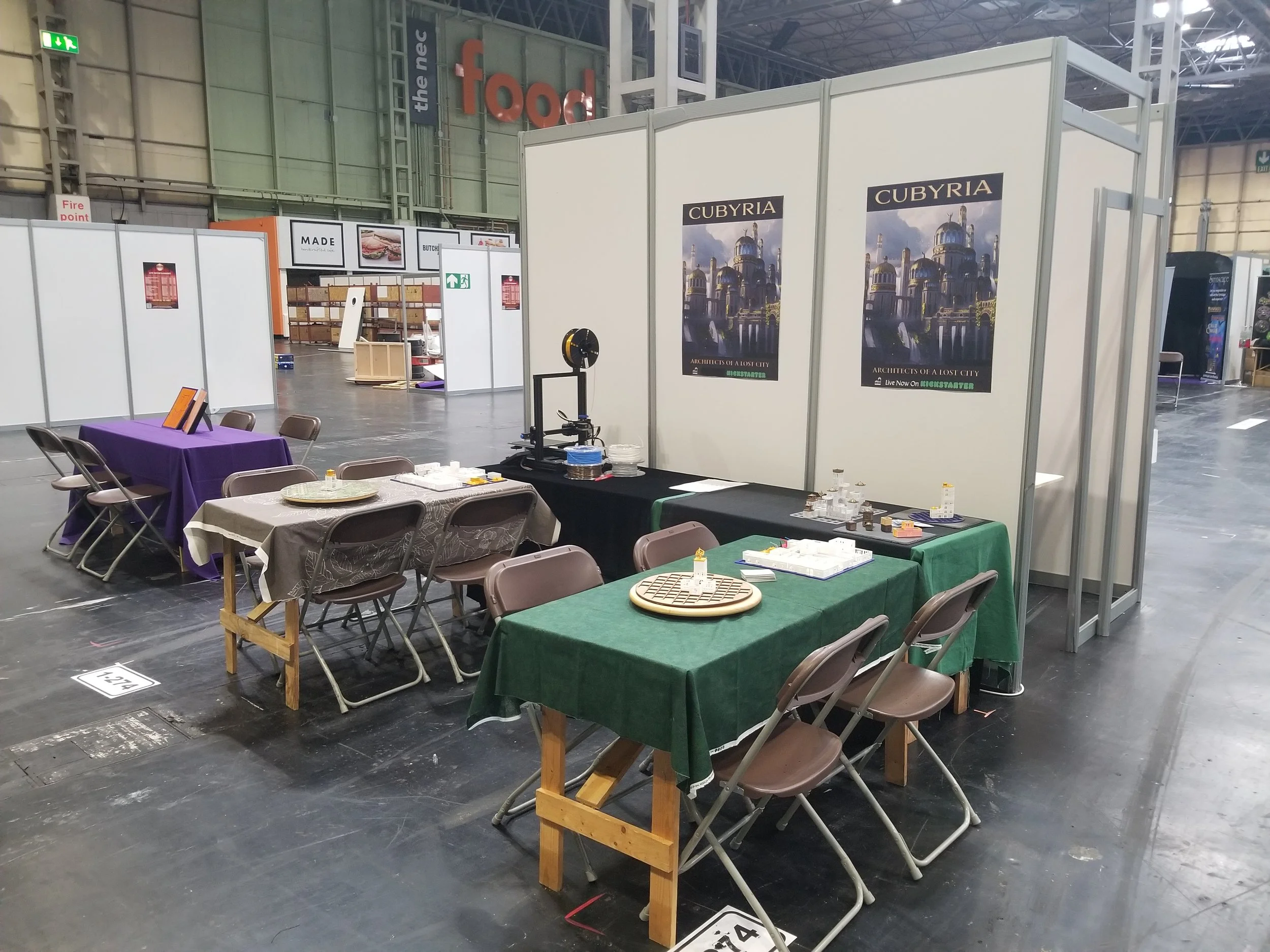
The problem was, Cubyria was designed around 3D-printing, and to match its form in injection-moulded parts would require very complex and expensive multi-part moulds. There was no way to manufacture it without cranking up the retail price to $300 or more, and this game was not in that market.
This forced a dilemma. There were ways to simplify and cheapen the design, but all of them reduced the aesthetic quality as well. It was the aesthetics that made Cubyria stand out. James had been told again and again by his convention guests that they’d spotted Cubyria from across the room and had come to get a closer look. In the end, the primary design driver of the game was that everyone, no matter whether they won or lost, would feel they had participated in the creation of something beautiful. Making it uglier was just not an option.
So, unable to resolve this dilemma, he sadly shelved the project.
Then one night at 4am, James sat bolt upright in bed. His old friend Keith had texted saying that he was looking for a change and might like to move to England. Keith has a whole career behind him in manufacturing, logistics and business development. James grabbed his phone and started madly texting, describing the game and the manufacturing problem and extolling the virtues of owning one’s own business, which he knew nothing about. He forgot that in Denver it was 9pm, and Keith was wide awake enjoying drinks for his birthday. Keith called. They had a long conversation and he agreed to come out for Airecon and see what the game was about.
Airecon sold him.
So, Keith and James agreed to form Cubyria Games, Ltd. In the past 15 months, we’ve brought Cubyria to nine conventions, where it’s been very warmly received. Keith has bent all his engineering talents to redesigning the components into a version that will arrive in pieces, but snap together strongly and beautifully, resulting in the same appearance and stuctural itegrity of the 3D-printed parts. The moulds required will be simple 2-part moulds, far cheaper to produce, bringing the price down to a reasonable level for hobby gamers. We are even exploring a patent.
Which brings us to today. We are poised to ignite this Kickstarter in the biggest way possible. We truly think that Cubyria is something special; it’s unique, tactile, beautiful and fun. We think it could join the pantheon of perennial games; those few special designs that gamers keep on their shelves and return to year after year. Join us for this most exciting moment in our journey.